
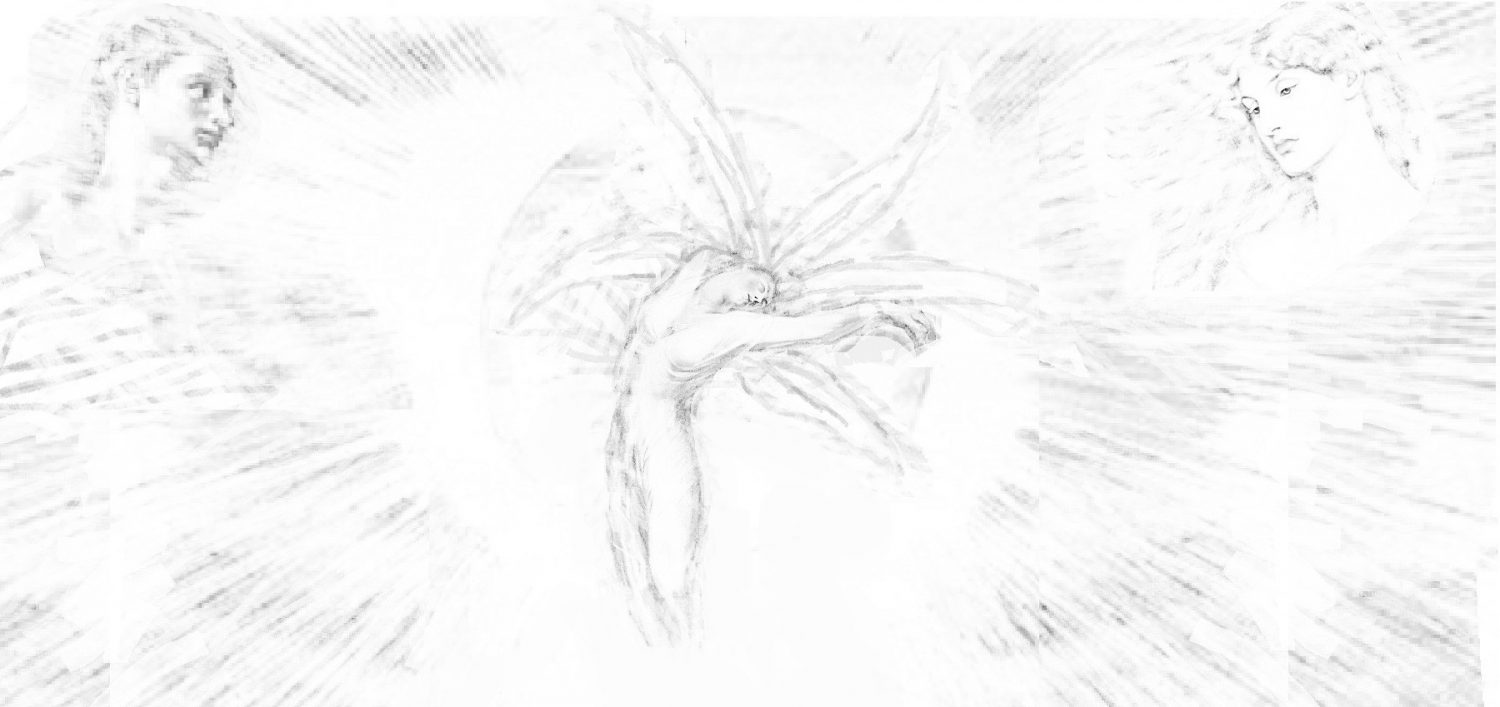
“Art and literature are my surrogate religions.” In a Gerhard Richter moment, Sir Peter Shaffer offered this statement to the Guardian’s Michael Billington in 2006, effectively placing himself among the playwrights who wear or have worn their creative codes like cassocks. The striking mark of Equus—the skirt of his particular code, represented by the above quote—on the cinema has faded (blame to Sydney Lumet) over decades, but the collar, Amadeus, has found permanence as a symbol of the praise and penetration of great art.
With the transfer from stage to reel of this Tony Award-winning, Pushkin-based tribute to the eighteenth century’s greatest musical prodigy, a transfer completed under the direction of the naturalist visionary, Milos Forman, Shaffer was almost immediately absorbed into the surrogate canon where Forman’s name had already been scratched beside the title of another of his adaptations, One Flew Over the Cuckoo’s Nest. Amadeus’s immense popularity with critics and audiences alike burned for more than a decade and a half before the opening of the Information Age. In the current era of video chat and selfies, it can be searched, along with only three or four other notable studies of the concept of the artist as a human being, under “awesome movies about classical music.”
What separates Amadeus from the string, running from Ken Russel’s repulsive Lisztomania to Bernard Rose’s decidedly mediocre Devil’s Violinist, of clumsy attempts to contextualize the Classical aural aesthetic is something of an idee fixe in the cinematic pantheon—the expert treatment of irony. Irony is one of several keys to any creative’s canonicity. Mediocrity is among the tools used by our accomplished duo to turn that key within their opus, rather than a quality of the opus, itself, the spirit of which is as unquiet, as universal as that of the centuries-enduring icon that climbs its toys, toys any great film must have as a playground of elements human and elements sublime. These red and green towers, bars, and slides take, in Amadeus, the shapes of aspects of a fatal obsession with two casualties: a man and a mind.
On this obsession, composer Antonio Salieri, in whose Vienna home the film opens, has the first and last words. Really, they are, together, a single word, the last being the pronoun of the first, which appears amidst the powerful first chords of Mozart’s overture to Don Giovanni, played by the legendary Neville Marriner and the Academy of St. Martin in the Fields orchestra, whose performance of the soundtrack is nothing less than awe-inspiring.
“Mozart!” Salieri shouts. “I killed you!” We get the feeling that he’s spent hours throwing confessions out his window to the city night. Would he convince it of his guilt, as he might convince himself? Shaffer and Forman answer by leading us through his door for the first time only after he’s shrieked in pain. Shimmering between three of his fingers is the letter opener with which he has unsealed a vein in his own neck.
Within moments, we’re following him and a trio of orderlies through the social effervescence of Austria’s capital to an asylum, the chaplain of which arrives in the morning to confess Salieri, bringing God along to judge, perhaps with forgiveness, though potentially with the breaking of another hopeful self-murderer’s rope upon a snap of His holy fingers. Yes, we run the danger here of being led amiss by the odor we’ve caught of Iscariot’s broken bowels. Best we keep in mind that we’re as yet a long way from climax and coda.
Because Salieri’s tone isn’t at all self-condemning or regretful when he says Mozart’s name to the priest for the first time. First, he asks him one of the most loaded questions in the film.
“How well are you trained in music?”
The priest has studied in Vienna, where Salieri previously held the position of court composer. Yet, after hearing two of the old maestro’s works on a dilapidated pianoforte, neither, he “regrets” to say, is familiar.
“Can you recall no melody of mine?” Salieri says, dropping his hands. “I was the most famous composer in Europe.”
The priest straightens his lips and casts a glance at the floor.
“Here—” Salieri taps the air with his index finger. “What about this?”
His confessor responds with an expression that conveys pity, expectedly, but also irritation. Perhaps he senses the doom of his clerical compassion to fruitlessness by the patent stamp of ignorance on his sensibility. Or maybe he already knows his interviewee better than we might think.
But, then, the theme of Eine Kleine Nachtmusik begins stroking his ear. He rolls his tongue to the notes with a grin.
“Yes, I know that.” He points to Salieri’s instrument. “I’m sorry; I didn’t know you wrote that.”
“I didn’t,” Salieri says, smiling back. He pauses as the priest’s cheeks and eyebrows fall. “That was Mozart.” He raises his head; our Iscariotesque impression of him fades into the bitter pauses between his next three words, whispered to the ceiling: “Wolfgang. Amadeus. Mozart.”
These sour silences expand alongside one another, merging to form a malevolent shadow of Typhon as Salieri guides us in flashbacks across decades, sermonizing behind his pointer finger on the mystery that is the call of music and on the torment of existing as a maestro “made… mute,” his imagination providentially sterilized. F. Murray Abraham plays Salieri’s melancholic syllables with mesmerizing insight and rubato while wielding the same persuasive power our director and our playwright use to make us believe (almost) that nothing the old composer shows us has been siphoned from one of Pushkin’s dreams, that all emerges, instead, from a gap in eighteenth-century reportage filled by a European estate beneficiary born a decade or two before 1950.
This includes, of course, our official introduction to Mozart (as portrayed by the characteristically and here appropriately neurotic Tom Hulce), whom we meet at Mozart’s own concert for the Prince-Archbishop of Salzburg, during Salieri’s prime. The event is just one of several “miracles” in Salieri’s narrative, though it’s the only one Salieri doesn’t announce as such (“A miracle,” he says just before his father dies of a heart attack; “A miracle” before the emperor yawns during the premiere of Mozart’s Le Nozze di Figaro). But the reason for the absence of the phrase at this moment, when Mozart appears for the first time as just the thing Salieri prays every night for the privilege of becoming in music—a conductor of the very emotional and spiritual energies of God—is less ironic than it first appears. It is, after all, woven into Salieri’s declaration of devotion to the praise of God’s glory, which, embellished with an oath of celibacy, comes only in part from a craving for uninhibited creative flow (“work and work and work…it was wonderful”). Let not labor be labor’s only reward.
“Everybody liked me,” he says. “I liked myself.” Everybody—a generalization perfectly fitting his true objective, which he explains: “While I was still playing childish games, he was playing music for kings and emperors. I told my father… how I wished I could be like Mozart.” “Kings and emperors” is Austria’s Joseph II, who, by most accounts, is a worthy target audience for any eighteenth-century Viennese composer, his royal opinion constituting law so well as culture in the “city of musicians.”
“Actually, the man had no ear at all,” Salieri tells the priest, “but what did it matter? He adored my music.” Inclusiveness is the point, but only as an emblem of divine condescension.
This is a worthy aim only from the perspective of the artist who dreams himself onto God’s knee: “Make me immortal. Let me celebrate your glory through music, and be celebrated myself.” The godly snob speaks here. None but the godly snob, flowering alongside the godly servant, requests such divine favor twice. The snob within Salieri almost compulsively begs, or it soliloquizes, noisily reaping all divine boons—recommendations, commissions, glittering gold stars hung on ribbons—throughout Salieri’s career, while teaching him to expect grace in an artist of Mozart’s promise. Mozart offends it deeply upon revealing himself with two words in the Prince-Archbishop’s dining hall.
“My music,” he says, overhearing woodwinds. Where is the youth envisioned, with talent “written on the face?” Who is this “child,” this “giggling, dirty-minded creature… crawling on the floor?” Like a cackling, contorted effigy of Jim Morrison, Mozart has fondled Constanze Weber under a dessert table while spinning phrases meant to be uttered by nobody past monkey-bar age. He is fortunate that the flowering fräulein is no Puritan, herself. Compelled to call him a “fiend,” she has still been inclined to accept his proposal of marriage, delivered backward (“em yrram”) in the manner of the far less flattering first sentence he’s uttered as her will-be husband.
After thus fortuitously introducing himself to Austria’s court composer, he runs to illuminate every face in the Prince-Archbishop’s banquet hall with the sublime third movement of the Serenade for Winds, a piece that Salieri, in disbelief, only moments after Mozart has accepted a standing ovation for it, deems “an accident” while reading its score. “It had to be,” Salieri says. A puck the mouthpiece of Israfel? “It’d better be.” But, deliberately as any of Salieri’s prayers is finished, so is this music, but “as music is never finished.” Never has Salieri been so powerless to avoid getting swept away by a colleague’s sound, which accounts for his seeming inability to avoid artistic confinement by criticism—prompted by the all-too-honest conduct of this particular sound’s creator—of sacred selection. Inevitable, thus, is the establishment, by snob, of Salieri’s rostrum in the global congregation of mediocrities, in which he later claims nothing less than sainthood as a failed usurper.
He raises his plan of overthrow from multiple seeds sown in the ashes of a crucifix—“From now on, we are enemies,” he whispers, recounting its burning in his study—seeds of circumstance and envy, some supplied him by two of the souls he patronizes: the royal court’s clammy kapellmeister, Bonno (Patrick Hines), and starchy artistic director, Orsini-Rosenberg (Charles Kay), who seethe and scheme alongside him in favor, ostensibly, of tradition and high culture. Mozart provides other seeds, himself, though unwittingly, entirely blindsided by his self-canonized antithesis. His defenses against the manifold threats in that one’s pocket to his livelihood, his marriage, his reputation, everything but his compulsions, fall unmanned so that he is left, in the end, with little more—more being the unfinished “Requiem in D Minor”—than a mess of garter belts and empty bottles of wine.
Fitting, as he both suffocates and drowns. But he is neither strangled nor more than proverbially held under Malmsey, though his actual death is attributable to alcoholism brought on by his personal and professional losses, by the chill of European society, and by the agony in which he paints death in glorious sounds. His life’s finale, crawling across his creative odyssey like a millipede, radiates the postmodern heat of the pyre built by that most insidious of art’s demons, Futility, for all morality, all elitism, all ages. This may be Amadeus’ core irony, one of several paradoxes that make “Allegory” a categorization too obvious for it. If we get a feeling that the consequence of one’s losing one’s faith to jealousy—or one’s moral sense to the snob within—is its message, we can’t help noticing that Mozart, God’s “own beloved,” immodest though unpretentious, never prays. If our minds breed less biblical terms, and we assume the concept of ideal vs. reality is the theme, we’re corrected as we watch Forman take off every wig, dress, and robe (magnificently designed by Theodor Pistek) under frank, natural lighting, while leaving the music’s divine illusions—enlivened vocally by the talents of June Anderson, Willard White, Samuel Ramey, and Felicity Lott—intact.
“Art and literature are my surrogate religions.” Fortunately for art, all but itself is futile here. This is the film’s premise. Art fills Salieri’s mind at the close—when the Age of Enlightenment is no more and the Classical ideal of transcendence is dead—poeticizing, even at last consuming his bitterness against the favorite of God, God who “killed Mozart, but kept me alive to torture” with years, “thirty-two years of watching myself slowly become extinct.” His obsession with Mozart, then, doesn’t concern Mozart, himself, even if this obsession is the ultimate undoing of prodigy and “mediocrity” both. No, but it concerns the love of, the craving for, the poison of effortlessness at creating—and the even deadlier toxin in the envy of that effortlessness—great art. Great art, the art of Amadeus, fills our ears as his world and Salieri’s vanishes into credits. It survives all but God, putting us in Shaffer’s seat and making us wonder, too, if it might serve as a defensible substitute for Him.
Louis Arevalos
All rights reserved
 Everyone's Aesthete
Wonderful explanation of Amadeus. Well put and well said.
LikeLike